
Table of contents
- The Complexity of Measuring AA Success Rates
- What Recent Research Reveals About AA Effectiveness
- Understanding How 12-Step Groups Work
- Comparing AA to Other Treatment Options
- The Science Behind AA Success
- Factors Influencing Individual Success Rates
- Criticisms and Limitations
- AA in Context: The National Institute Perspective
- The Role of Treatment Facilities
- Long-Term Outcomes and Recovery Village Data
- Making an Informed Decision
- The Bottom Line
Understanding Alcoholics Anonymous’ success rate statistics is crucial for anyone considering 12-step programs as a path to recovery from alcohol use disorder. With more than 115,000 AA groups across the United States and worldwide, Alcoholics Anonymous remains one of the most widely available treatment options for alcohol addiction. But what do the numbers actually reveal about AA’s effectiveness?
The Complexity of Measuring AA Success Rates
Determining the success rate of AA presents unique challenges. The anonymous nature of AA meetings makes it difficult to track long-term outcomes. Additionally, the definition of “success” varies. Some measure continuous abstinence, while others consider reduced drinking or improved quality of life as meaningful progress.
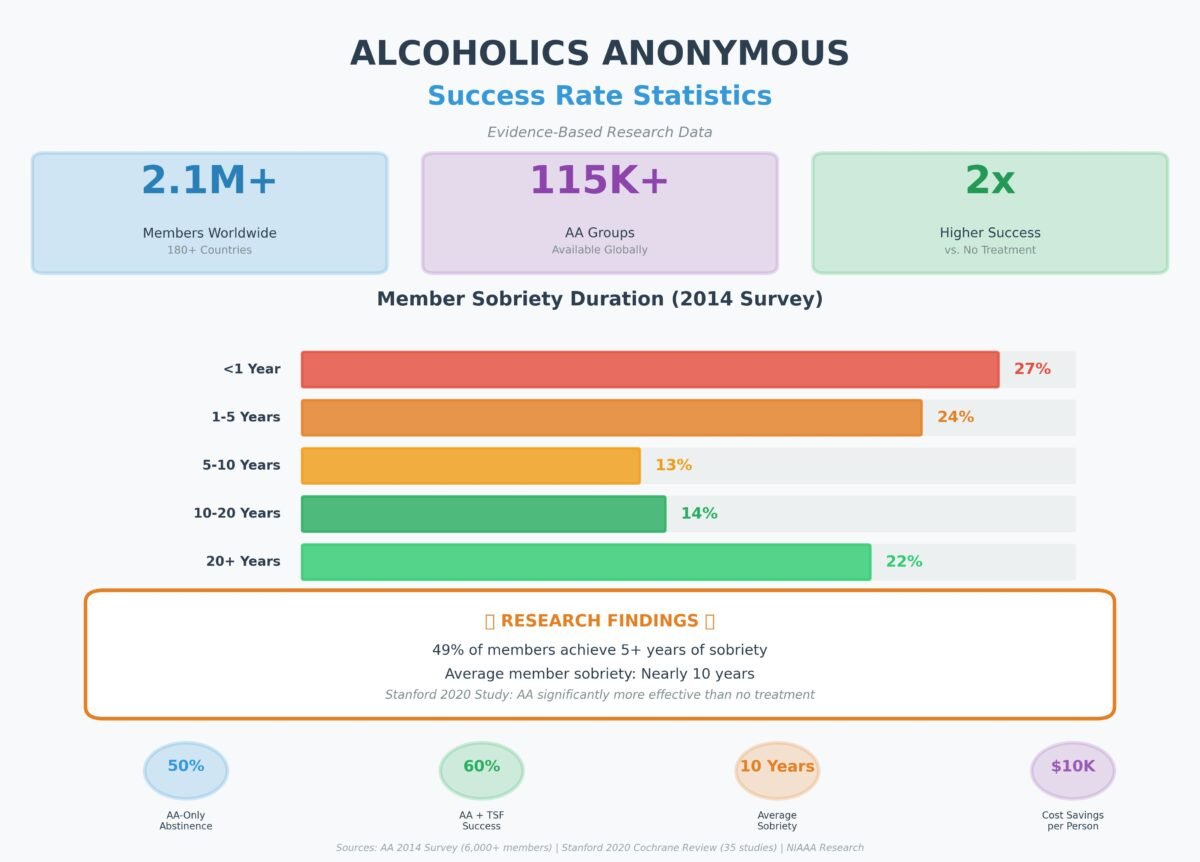
According to AA’s own membership survey conducted in 2014, which included over 6,000 study participants, the recovery rates break down as follows:
- 27% of AA members maintained sobriety for less than one year
- 24% stayed sober between one and five years
- 13% achieved five to ten years of continuous sobriety
- 14% maintained abstinence for ten to twenty years
- 22% celebrated over twenty years of long-term sobriety
The Big Book, AA’s foundational text written by Bill Wilson and Dr. Bob Smith, claims approximately a 50% success rate, with another 25% achieving sobriety after experiencing alcohol relapses.
What Recent Research Reveals About AA Effectiveness
A groundbreaking 2020 study from Stanford Medical School, led by Professor of Psychiatry Keith Humphreys, conducted a comprehensive Cochrane Review analyzing 35 studies involving 10,080 participants. This research represents the gold standard in evaluating the effectiveness of Alcoholics Anonymous and 12-step programs.
The findings were remarkable: abstinence rates were approximately twice as high among those who attended AA meetings compared to those who received no treatment. In some studies, AA groups demonstrated a 60% higher success rate than alternative interventions. Most striking finding? No study has found AA to be less effective than other treatment approaches.
The Cochrane Collaboration’s systematic review concluded that AA participation and Twelve-Step Facilitation therapy led to higher rates of continuous abstinence compared to established treatments like cognitive behavioral therapy, while also generating significant healthcare cost savings, in some cases, reducing mental health expenses by $10,000 per person.
Understanding How 12-Step Groups Work
The AA program centers on peer support through regular meetings where AA members share their experiences with alcohol problems and drug addiction. New members typically select a sponsor, a more experienced member who guides them through the twelve steps outlined in the Big Book.
The 12-step philosophy emphasizes several key components:
Peer-Led Support Group Dynamics: Unlike professional treatments requiring medical professionals, AA meetings are peer-led meetings where members of AA support each other without formal addiction treatment requirements.
The Role of Higher Power: While often misunderstood as promoting a particular religion, the concept of a higher power in AA can be interpreted individually, allowing for spiritual experiences that align with personal beliefs.
Home Group Connection: Active members often maintain a home group, a regular meeting where they feel most connected to other AA participants.
Working the Steps: From the first step of admitting powerlessness over alcohol to the twelfth step of helping other alcoholics, the 12-step meetings provide structure for recovery programs.
Comparing AA to Other Treatment Options
Research comparing AA to professional treatments reveals interesting patterns. While evidence-based treatments like cognitive behavioral therapy and motivational enhancement therapy are effective, AA participation shows comparable or superior outcomes in many studies, particularly for achieving complete abstinence.
Smart Recovery, another peer support program that takes a different approach, offers an alternative path. The official website of the General Service Office notes that recovery takes different paths for different individuals.
The Science Behind AA Success
Academic research from institutions like Harvard Medical School and Massachusetts General Hospital has identified several mechanisms explaining AA’s positive effect:
Social Support Networks: Regular attendance at AA meetings creates sober social connections, replacing environments where alcohol use was prevalent.
Behavioral Changes: The 12-step program promotes specific behavioral modifications that support long-term abstinence.
Reduced Healthcare Costs: Studies show AA participation leads to fewer medical complications from alcohol abuse, reducing overall formal treatment needs.
Long-Term Engagement: Unlike time-limited professional treatments, AA offers indefinite peer support, which research links to better long-term outcomes.
Factors Influencing Individual Success Rates
The percent success rate of AA varies based on several factors:
Meeting Attendance: Higher levels of attendance correlate with better outcomes. Those attending the first meeting who continue to regular meetings show significantly higher recovery rates than those who attend sporadically.
Prior Treatment: According to the membership survey, 59% of AA members received some form of professional treatment or counseling before joining AA, and 74% stated that it played a significant role in leading them to the program.
Dual Participation: Many AA participants benefit from combining 12-step meetings with formal addiction treatment, including cognitive behavioral therapy and medication-assisted treatment for alcohol use disorder.
Active Participation: AA meeting attendance alone isn’t enough; active involvement through sponsorship, step-work, and service appears crucial for success.
Criticisms and Limitations
Despite the positive outcomes in many studies, critics highlight certain limitations. Some researchers cite success rates as low as 5-10%, arguing these rates are similar to natural recovery rates for those who quit drinking without intervention. The abstinence rate debate continues, with some questioning whether AA’s effectiveness differs significantly from what occurs with drug use cessation without formal programs.
Additionally, the spiritual component doesn’t resonate with everyone. Alternative programs like Narcotics Anonymous for drug problems, or secular recovery options, may better serve some individuals with substance use disorders.
AA in Context: The National Institute Perspective
The National Institute on Alcohol Abuse and Alcoholism has funded years of research on 12-step philosophy and outcomes. A significant study followed formally treated, informally treated (AA-only), and untreated individuals with alcohol problems over multiple years. At the 3-year follow-up, results showed that approximately 50% of those who entered AA on their own maintained abstinence, compared to roughly 25% of those in formal treatment programs only.
The Role of Treatment Facilities
An additional 32% of AA members were introduced to the program by treatment facilities. Many rehabilitation centers integrate AA participation with other evidence-based treatments to create comprehensive aftercare programs. Medical professionals increasingly recognize that referring patients to 12-step meetings works best when combined with Twelve-Step Facilitation counseling, creating what experts describe as “an extended, warm handoff into the fellowship.”
Long-Term Outcomes and Recovery Village Data
Project MATCH, a landmark study tracking outpatient samples over extended periods, provided valuable insights into long-term success. The study achieved an impressive 82% retention rate at the 10-year follow-up, demonstrating that many individuals who engage with AA groups experience sustained recovery.
Research also shows that 80% of people with substance use disorders who achieved recovery reported better job opportunities, higher education attainment, and stronger family connections, outcomes related to their participation in recovery programs, including AA.
Making an Informed Decision
For individuals struggling with a drinking problem or alcohol use disorder, understanding Alcoholics Anonymous’ success rate statistics helps make informed decisions about the best path forward. While AA shows strong effectiveness, particularly when combined with other treatments, it’s not the only option.
Consider these factors when evaluating whether AA fits your recovery needs:
- Your comfort with the 12-step program’s spiritual elements
- Availability of AA groups in your area and their accessibility
- Whether you prefer peer-led versus professionally-led interventions
- Your previous experience with different treatment approaches
- The presence of co-occurring mental health disorders requires professional treatment
The Bottom Line
Current research, including the definitive Cochrane Review and Stanford studies, provides robust evidence that AA and 12-step groups offer an effective path to recovery from alcohol addiction. The data shows that AA participants often achieve higher abstinence rates than those using other approaches, while the program’s free, widely available structure makes it accessible to anyone seeking help.
However, recovery is personal. What constitutes a good thing for one person may not work for another. The most important step is taking action, whether that’s attending your first AA meeting, exploring Smart Recovery, seeking cognitive behavioral therapy, or combining multiple approaches.
If you or someone you love is struggling with alcohol abuse or drug addiction, resources are available. AA meetings can be found through the official website of the General Service Office, while phone numbers for local groups provide immediate access to peer support. Remember that seeking help, in whatever form resonates with you, is always the right choice.
The evidence is clear: for many people battling alcohol use disorder, Alcoholics Anonymous provides a proven, effective, and supportive path to lasting recovery. The question isn’t whether AA works; the research confirms it does for millions of people worldwide. However, the question is whether it’s the right fit for your unique recovery journey.