
AA Quotes on Hope: Best Lines From the Big Book and the Rooms
Hope is a hard thing to hand to another person. You cannot mail it, prove it, or argue anyone into it.
What you can do is say something true out loud and trust that it lands. Most AA quotes on hope started that way: a sentence somebody said in a bad moment that other people kept repeating because it helped.
What follows are lines from the Big Book of Alcoholics Anonymous, sayings you will hear at almost any AA meeting, and words from a few voices outside the program. They are in no particular order of importance.
Read them slowly. If one of them catches you, write it on an index card and keep it where you will see it.
Why AA Quotes on Hope Land Differently on a Bad Day
There is a particular kind of bad day in early sobriety where nothing dramatic happens, and everything still feels heavy. No crisis, no obvious trigger, just a low hum of negative emotions you cannot reason your way out of.
That is the day a short line does more than a long explanation. Your own thinking is the thing that is off, so a borrowed sentence gives you something outside your own head to hold onto.
People sober a long time keep quotes around for exactly this reason. It is not sentimentality. It is a practical tool for the hours when your own good ideas have run out.
The first time you try it, repeating a line to yourself can feel a little silly. Say it often enough on a hard day, and you will notice it starts doing real work.
Hard times are also when memory goes unreliable. You forget how bad it was, you forget what worked, and a written line is the one part of your recovery that cannot be talked out of the room by your own mood.
Hope in the Big Book of Alcoholics Anonymous
The Big Book is not a book of comfort. It opens with a doctor’s blunt medical opinion and moves quickly into the wreckage of an alcoholic life.
That is exactly why the hope in it carries weight. Nobody is being talked into anything, and nothing is being dressed up.
The Doctor’s Opinion and Little Hope of His Recovery
Dr. William Silkworth wrote the section that opens the book, and he did not soften his conclusions. He described people who, once they take a first drink, show an utter inability to stop, and he wrote that without an “entire psychic change” there was “little hope of his recovery.”
Read that cold, and it sounds like a verdict. Read it the way AA members read it, and it turns into the opposite, because the entire book that follows exists to describe what that change looks like when it actually happens.
The good news buried in the Doctor’s Opinion is that Silkworth had watched the change occur in real patients. He was not speculating.
The Baffling Feature of Alcoholism
Later, the book names what it calls the “baffling feature of alcoholism,” meaning that a person remembers exactly what happened last time and picks up anyway. Anyone with a drinking problem has lived inside that contradiction.
There is real hope in seeing it written down. If a book published in 1939 describes your private experience in detail, then you are not uniquely broken, and you are not the only person this has ever happened to.
The second chapter is titled “There Is a Solution.” That title alone has probably kept more people in their seats than any argument in the text, which says something about how the most important things are often said in the fewest words.
The book makes its boldest claim at the start of chapter five, before it has asked anything of you.
Rarely have we seen a person fail who has thoroughly followed our path. Those who do not recover are people who cannot or will not completely give themselves to this simple program, usually men and women who are constitutionally incapable of being honest with themselves.
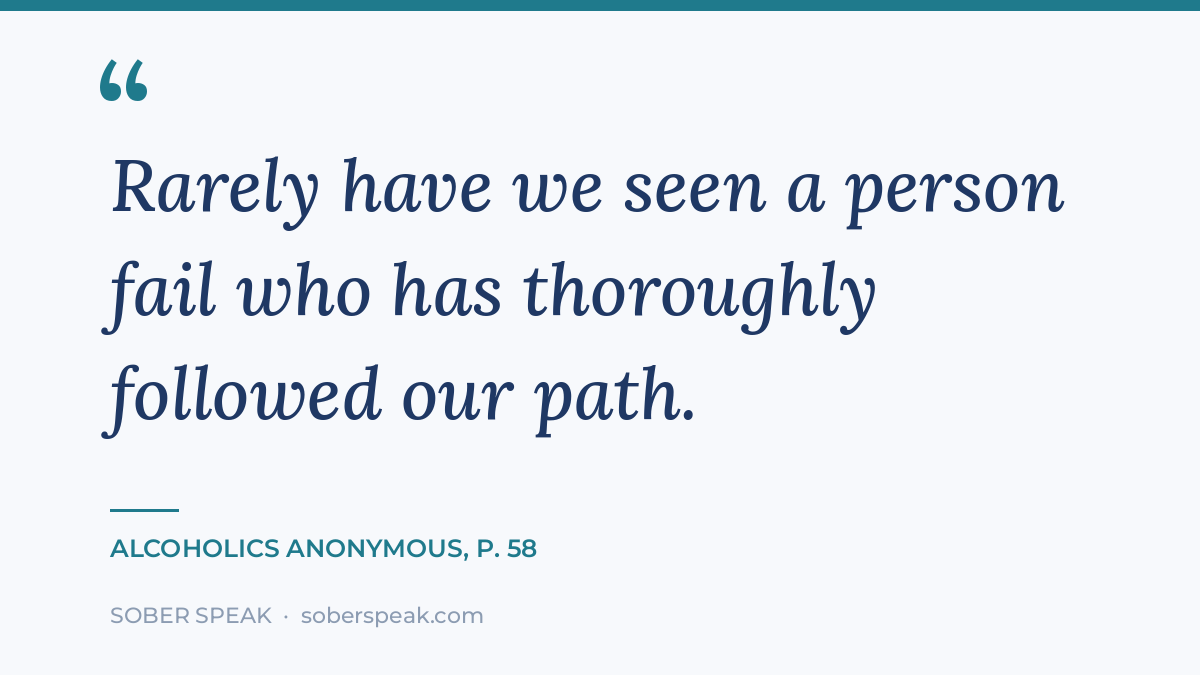
That sentence has been read aloud at the start of meetings for more than eighty years. It puts the odds in your favor and tells you exactly what the price is.
Selfishness at the Root of Our Troubles
In its chapter on the third step, the book offers its most direct diagnosis. Selfishness and self-centeredness, it says, are the “root of our troubles.”
That reads as harsh until you sit with it a while. If the problem is something inside you rather than something in your circumstances, then it is finally something that can change.
The same passage speaks of being freed from the “bondage of self.” For many people, the biggest fear is that they are simply stuck as they are, and that short phrase answers it better than any pep talk.
Fear, and What the Book Says About It
The fourth step asks people to look honestly at the forms of fear running underneath their behavior. Fear of losing something, fear of not getting something, fear of being found out.
AA literature describes resentment and fear as forms of spiritual disease rather than character flaws you were born with. Diseases can be treated, which is a more hopeful frame than most people arrive with.
The promise attached to that work is not that fear disappears. It is that fear stops running the show, and you begin to have some say in the matter.
Higher Power Quotes and the Spiritual Experience
Plenty of people reach the second step ready to walk out the door. The word God shows up early and often, and for some that is where the conversation stops.
The literature anticipates this. It asks only for an open mind and a profound desire to be free, not for certainty about anything.
Coming to Believe in a Power Greater Than Yourself
The second step does not ask you to believe. It says people came to believe, which is a process rather than a decision you make on a Tuesday.
That single word “came” is one of the most quietly hopeful things in the whole program. It gives you permission to arrive slowly.
Your higher power can start as the group itself, as the ocean, as the honesty in a room full of ordinary people. The point is simply that you are no longer the only person in charge.
A Spiritual Awakening Is Usually Slow
The book is clear that a spiritual awakening rarely arrives as a lightning bolt. For most people it develops slowly, so gradually that friends notice the change before they do.
This is worth repeating to yourself if you are waiting for a dramatic spiritual experience and feeling like a failure for not having one. Slow counts. Slow is the common way people get well.
Aldous Huxley, who knew a great deal about both mysticism and human folly, once called Bill Wilson the greatest social architect of the century. He was not describing a miracle. He was describing something built, one relationship at a time.
Humility, and Asking for God’s Help
The seventh step is where humility stops being an insult. AA literature frames it as a matter of seeing yourself accurately, which turns out to be a relief rather than a demotion.
The suggestion is that some degree of humility is the starting point for every real change a person makes. You cannot ask for help while insisting you do not need any.
Asking for God’s help, however you understand that word, is not about grovelling. It is about admitting the obvious: willpower alone has already been tried thoroughly and did not hold.
Plenty of people say the words long before they mean them. That is allowed, and it works more often than it has any right to.
A Spiritual Axiom Worth Carrying
AA literature describes a spiritual axiom that is worth writing down: when you are disturbed, no matter how justified the disturbance looks, there is something in you that needs attention.
That is not a scolding. It is a door, and it means you always have somewhere to go with a feeling instead of nowhere.
AA Prayers About Hope, Printed in Full
Some of the most quoted lines in the fellowship are prayers rather than sayings. People who arrived as skeptics often end up saying them anyway, because the words ask for exactly the right things.
Here they are in full, so you do not have to go hunting for them.
The Serenity Prayer
This is the one that opens meetings around the world. It is not owned by Alcoholics Anonymous, and it predates the fellowship, which is part of why it travels so well.
God, grant me the serenity to accept the things I cannot change, courage to change the things I can, and wisdom to know the difference.
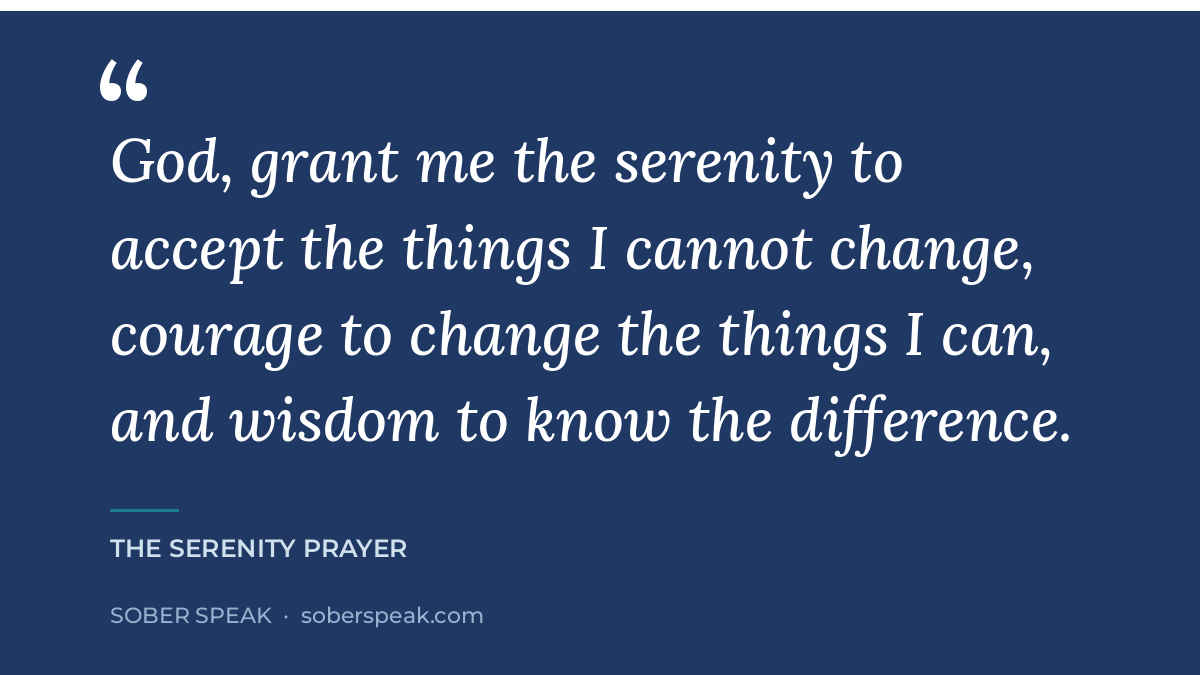
Three requests, and every one of them is available today. Notice that it does not ask for the situation to improve.
Most people find that the middle line is the hardest. Acceptance and wisdom are quiet work, but courage has to be done out loud.
The Third Step Prayer
The Third Step Prayer appears on page 63 of the Big Book of Alcoholics Anonymous, right after the step is explained. Many people say it with their sponsor the first time and then keep saying it for years.
God, I offer myself to Thee, to build with me and to do with me as Thou wilt. Relieve me of the bondage of self, that I may better do Thy will. Take away my difficulties, that victory over them may bear witness to those I would help of Thy Power, Thy Love, and Thy Way of life. May I do Thy will always!
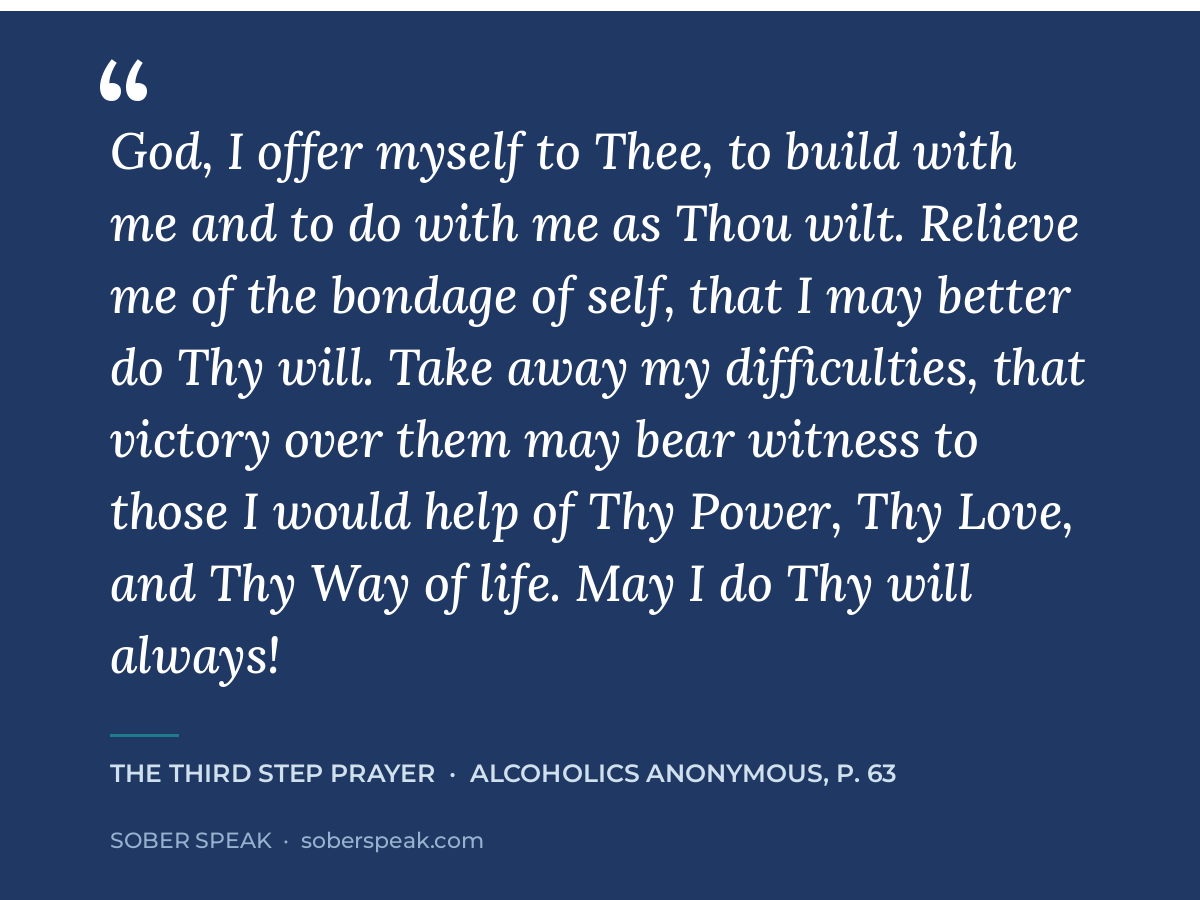
Look at what it actually requests. Not comfort, not luck, not the removal of consequences, but relief from the bondage of self.
The last line is the hopeful part. It assumes there will be a tomorrow in which to do this again.
The Seventh Step Prayer
The Seventh Step Prayer sits on page 76, at the moment a person becomes willing to have their character defects removed. It is short, and it is specific.
My Creator, I am now willing that you should have all of me, good and bad. I pray that you now remove from me every single defect of character which stands in the way of my usefulness to you and my fellows. Grant me strength, as I go out from here, to do your bidding. Amen.
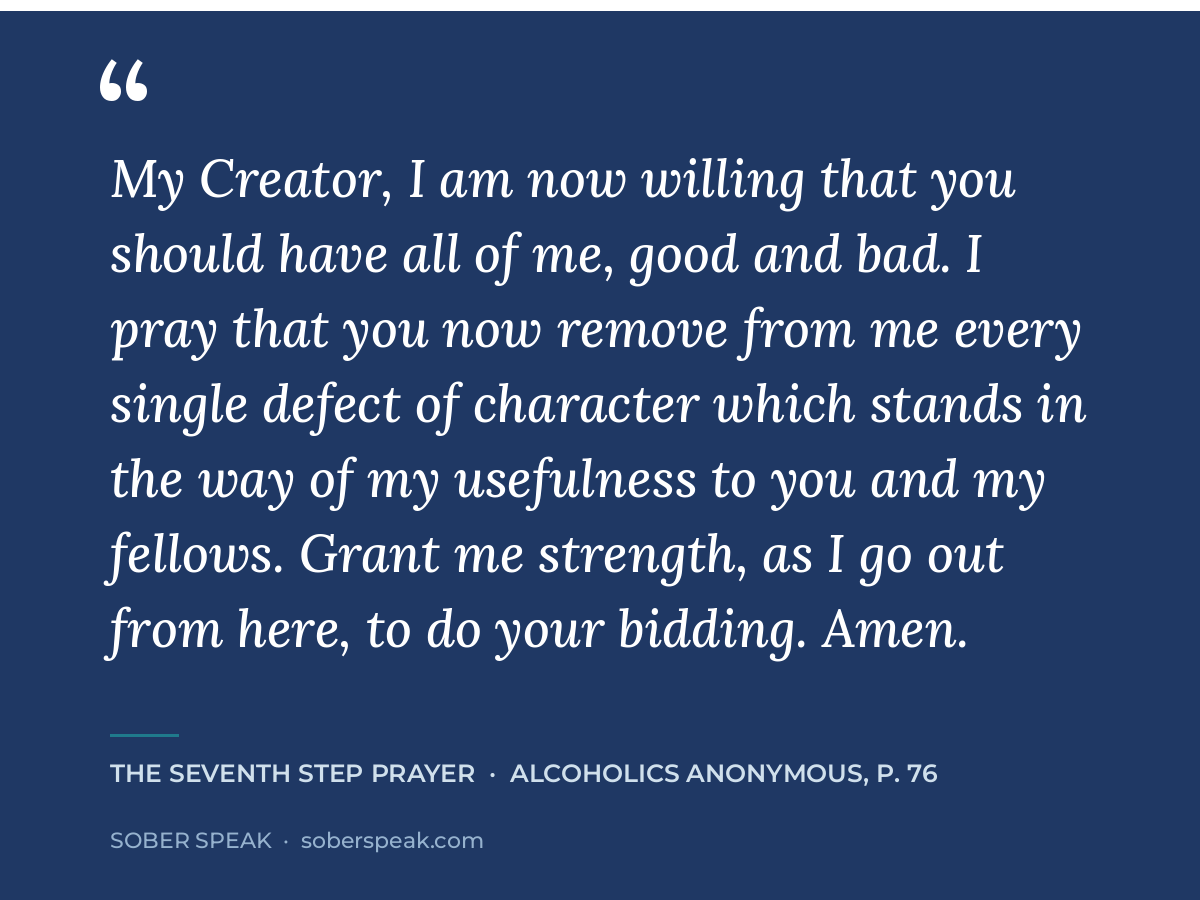
The phrase that carries the hope is “all of me, good and bad.” Nobody is asked to clean up first.
It also names the standard by which defects are judged: usefulness to other people rather than personal perfection. That is a far kinder measure than most people apply to themselves.
The Eleventh Step Prayer of Saint Francis
The eleventh step points people toward the prayer commonly attributed to Saint Francis of Assisi. It is centuries older than the program and belongs to no one, which suits a fellowship built on anonymity.
Lord, make me an instrument of your peace. Where there is hatred, let me sow love; where there is injury, pardon; where there is doubt, faith; where there is despair, hope; where there is darkness, light; where there is sadness, joy. O Divine Master, grant that I may not so much seek to be consoled as to console, to be understood as to understand, to be loved as to love. For it is in giving that we receive, it is in pardoning that we are pardoned, and it is in dying that we are born to eternal life.
Read the whole thing and notice that it never once asks for relief. Every request is for the chance to give something away.
That is the eleventh step’s quiet trick. People who pray for the ability to console usually end up consoled, and they rarely notice it happening.
Recovery Sayings and AA Slogans From the First Step On
The slogans get mocked, sometimes by the same people who repeat them under their breath in a parking lot. They are short because they have to work when your thinking is not.
Here are the ones people actually use, and what they mean once you have needed them.
One Day at a Time
Nobody can promise not to drink for the rest of your life. That number is too big to hold, and trying to hold it is how people talk themselves into a first drink.
One day at a time shrinks the task to a size a human being can carry. You are not signing anything. You are getting through today.
Some days it becomes one hour at a time, and that still counts as much progress. There is no such thing as a day that was too small to matter.
First Things First
When everything is urgent, nothing gets done. First things first is a triage tool for people whose lives have several fires burning at once.
Staying sober is the first thing. The job, the relationship, the debt, and the rest of it all depend on it, and almost none of them get better while you are still drinking.
This is also the answer when someone hands you a five-year plan in your first week. Your next step is smaller than that, and smaller is fine.
Easy Does It, and Progress Not Perfection
Early sobriety brings a strange burst of energy, and there is less danger of excitement carrying you somewhere unhelpful when you keep the day simple. Easy does it is a brake, not a scold.
Progress, not perfection, is the line that keeps people from quitting over a bad week. You do not need a first-rate mind or a flawless record to work this program.
You need to keep moving in the right direction. That is genuinely the whole standard.
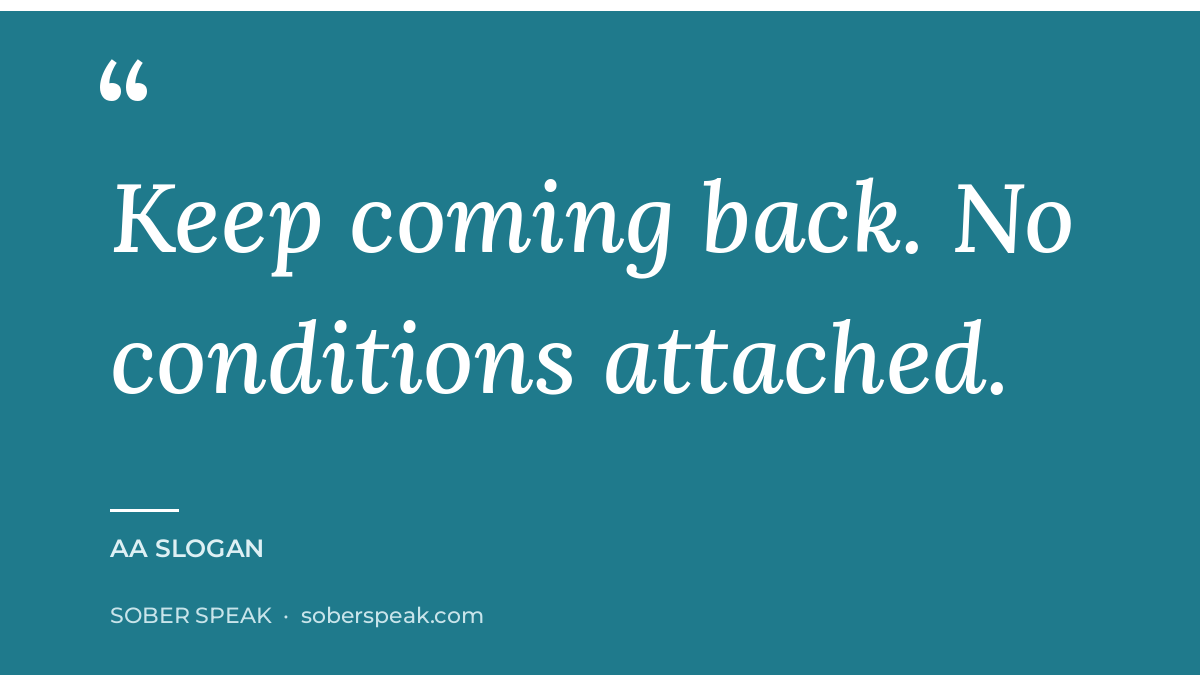
Keep Coming Back
It sounds like a goodbye at the end of a meeting. It is actually an invitation with no conditions attached.
Keep coming back means the door does not lock behind you if you leave, and it does not lock behind you if you drink. Very few institutions in adult life make that offer.
Acceptance Quotes for the Problems of Today
One of the most quoted passages in the whole Big Book comes from a personal story near the back, written by a man who found that his suffering traced back to a single habit. When he was disturbed, it was because he found some “fact of my life” unacceptable, as he put it.
His conclusion is repeated at meetings constantly. Acceptance turned out to be the answer to all his problems today, not because the facts changed, but because fighting them was what hurt.
This is easy to misread as giving up. Acceptance is closer to putting down a rope you have been pulling on for years while the other end was tied to a building.
You have little control over most of the situations that upset you. You have quite a lot of control over what you do next, and that trade is better than it sounds.
The Ninth Step Promises and a Better Life
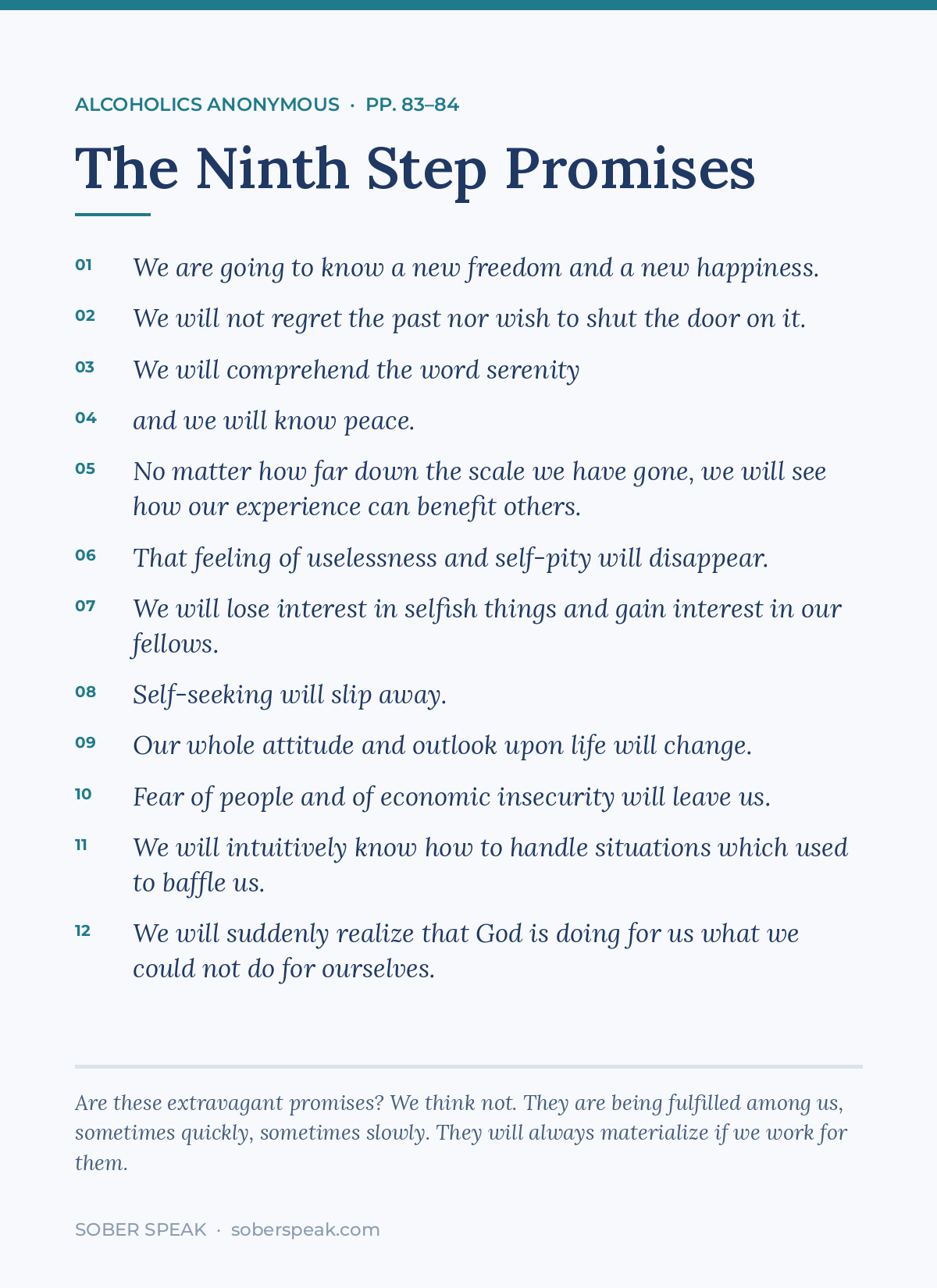
The promises appear in the middle of the chapter on making amends, and they read like an unreasonable list. Here they are, from pages 83 and 84 of the Big Book.
If we are painstaking about this phase of our development, we will be amazed before we are halfway through. We are going to know a new freedom and a new happiness. We will not regret the past nor wish to shut the door on it. We will comprehend the word serenity, and we will know peace. No matter how far down the scale we have gone, we will see how our experience can benefit others. That feeling of uselessness and self-pity will disappear. We will lose interest in selfish things and gain interest in our fellows. Self-seeking will slip away. Our whole attitude and outlook upon life will change. Fear of people and of economic insecurity will leave us. We will intuitively know how to handle situations which used to baffle us. We will suddenly realize that God is doing for us what we could not do for ourselves.
Are these extravagant promises? We think not. They are being fulfilled among us, sometimes quickly, sometimes slowly. They will always materialize if we work for them.
The book asks the skeptical question on your behalf and then answers it plainly. Old timers will tell you it is one of the few promises in life that keeps arriving.
What makes it credible is the placement. Nobody hands you this list at the door. It sits after the hardest work in the program, once you have swept your side of the street.
The Big Book also talks about how true ambition changes shape in recovery. It stops being about getting ahead of people and becomes about being useful to them.
That is where inner peace tends to show up. Not as a mood, but as the ordinary result of not having anything left to hide.
Inspirational Quotes From Outside the Rooms
Not every line that helps came out of AA literature. People bring in what works, and some of these motivational quotes have been read aloud at meetings for decades.
On Falling Down and Getting Back Up
The line about our greatest glory being not in never falling but in rising every time we fall is usually credited to Ralph Waldo Emerson, though its history runs back further than that. Either way, it belongs in a room full of people who have gotten up more than once.
Vince Lombardi put the same idea in plainer terms, saying it is not whether you get knocked down but whether you get back up. Coaches and sponsors do similar work.
Martin Luther King Jr. argued that the ultimate measure of a man is not where he stands in comfort but where he stands in times of challenge. Recovery is one long test of that idea, and most people pass it more often than they give themselves credit for.
On Starting Over
There is a well worn saying, usually attributed to Carl Bard, that no one can go back and make a brand new start, but anyone can start today and make a new ending. It gets read at anniversaries constantly, and it earns its place.
Henry Ford’s line about how whether you think you can or think you cannot, you are right, sounds like a poster until you have watched somebody talk themselves out of a meeting. Then it sounds like a warning.
Eleanor Roosevelt said we must do the thing we think we cannot do. Anyone who has made a phone call they dreaded on the ninth step knows the feeling on the other side of that sentence.
On Being a Little Kinder
Near the end of his life, Aldous Huxley said it embarrassed him that after a lifetime studying the human condition, the best advice he had was to try to be “a little kinder” to one another. Coming from a man of that intellect, it is disarming.
It is also close to what the twelfth step asks. Carry the message, be useful, and let the results take care of themselves.
If you can only manage one thing on a difficult morning, do some good today for somebody else. It works on your own head faster than almost anything you can do for yourself.
On Sitting With What You Cannot Change
Jon Kabat-Zinn, who brought mindfulness practice into mainstream medicine, is often quoted as saying you cannot stop the waves, but you can learn to surf. That is the eleventh step in one sentence, without any of the vocabulary that makes people flinch.
Samuel L. Jackson has been open for years about getting sober in the early nineties and going straight from treatment into the work that made his career. His story is a useful piece of evidence that the best days are not necessarily behind you.
One favorite that gets passed around, about being braver and stronger and smarter than you believe, is usually credited to A.A. Milne. It actually comes from a later Winnie the Pooh film rather than the original books, which is a small and forgivable thing, and the sentiment is a beautiful truth regardless.
Quotes for Human Beings Who Are Starting Over
The fifth step asks people to admit the exact nature of their wrongs to God, to themselves, and to another human being. That last part is the one that terrifies everybody and helps the most.
Something changes when a secret is spoken to a person who does not flinch. You stop being a case and go back to being one of the whole people in the room.
The program was built by and for ordinary people. Not saints, not experts, not anyone with a special gift for spiritual values.
That is a solid foundation to build a life today on, precisely because it does not depend on you being exceptional. It only asks that you keep showing up.
What the AA Community Gives That No Quote Can
A page of anonymous quotes is a fine thing to carry in your pocket. It is not the same as sitting in a room with people who already know how your week went.
The Big Book puts real weight on this, describing what happens when “one alcoholic talks to another” as something that reaches a person nothing else can. Present-day AA members would say the same in plainer language.
Personal stories do work that argument cannot. When somebody describes their worst night out loud and then tells you what they did next, the hope in it is not theoretical.
Sponsorship asks for a lot of intimate time and gives back more than it takes. A sponsor is the person who has heard the whole inventory and treats you exactly the same afterward.
That relationship is also the safeguard against trading one problem for a new addiction, whether that is work, money, or another person. Somebody who knows your patterns will say something before you do.
How to Use AA Quotes on Hope in Everyday Recovery
Reading a list of quotes is pleasant. Using them takes a small amount of deliberate effort, and it is worth it.
Pick two or three, not twenty. Write them somewhere you will actually look, such as a phone lock screen, a bathroom mirror, or the inside cover of a notebook.
Bring one to a meeting and share about it. Saying a line out loud in front of people fixes it in memory in a way that reading never does.
When a decision looms, and you cannot see the whole path, fall back on the next right thing. You almost always know what that is, even when the larger picture is a fog.
The best way to make any of this stick is repetition rather than intensity. A line you say every morning for a month will outperform an inspiring afternoon you never repeat.
And keep an open mind about which quote is yours. People are often surprised by which line ends up carrying them, and it is rarely the one they expected.
Hope for Families Watching Someone They Love
Quotes about hope are not only for the person who drinks. Families often need them more, because they have been carrying the situation longer and have even less control over how it ends.
Al-Anon grew out of the same literature and offers its own sayings, and the sharpest one is the reminder that you did not cause it, you cannot control it, and you cannot cure it. That is not permission to stop caring.
It is permission to stop auditioning for a job that was never yours. Many families find that the moment they set that weight down is the moment anything starts to shift.
The Big Book devotes a full chapter to families, and its tone is notably gentle toward them. It expects the household to need its own repair, not just the person who was drinking.
If you love someone who is not ready yet, the most hopeful line available is also the most ordinary one. People do get well, often after everyone had stopped expecting it, and often for reasons nobody saw coming.
When Quotes Are Not Enough: Getting Help for Alcohol Addiction
Words help. They are not a substitute for medical care, and this is worth saying plainly.
Alcohol withdrawal can be dangerous and occasionally life threatening, so nobody should stop drinking heavily without talking to a doctor first. That is a fact of medicine, not a failure of willpower.
Many people find that addiction treatment and the twelve step program work best together rather than in competition. Treatment programs can stabilize the body and address other substance use disorders, while the fellowship handles the years that follow.
If you or someone you love needs a treatment center, look for licensed care, ask about aftercare planning, and take your time with the decision when you safely can. Support for alcohol addiction is far more available than it was when the Big Book was written.
Short Lines to Take to Your Next AA Meeting
If you want something to write down before you close this page, start here. These are the ones people reach for most.
- One day at a time, and one hour when the day is too long.
- Progress, not perfection.
- First things first, because everything else depends on the first thing.
- Keep coming back, no conditions attached.
- Easy does it.
- Acceptance is the answer to the problems in front of me today.
- The best way out is through, and through is shorter with company.
- You are not the only person this has happened to.
None of these will impress anybody at a dinner party. All of them have kept somebody sober through an afternoon that felt impossible.
That is the only test that matters for a line like this. It does not need to be profound. It needs to work at four in the afternoon on a Tuesday.
Carrying Hope Into the Rest of Your Life
The reason AA quotes on hope keep circulating is not that they are clever. It is that people tested them on their worst days and found they held.
You do not have to believe any of them yet. Borrow one, use it, and let it prove itself, which is what “keep an open mind” has meant all along.
The good day will come. Then another, and eventually a stretch of them long enough that you notice something has changed in you, quietly, without announcement.
That is the shape of addiction recovery for most people. Not a lightning strike. Just an ordinary human being, doing the next right thing, one day at a time.
This article is for information and encouragement only and is not medical advice. If you are struggling with alcohol or other drugs, please reach out to a qualified professional or a local recovery group.
Sober Speak was founded by John M. as a place for honest conversation about recovery, the kind of talk that happens in meetings but rarely makes it online. New episodes drop every Friday, featuring people sharing their experience with the 12 steps, sobriety, and the work of staying well.
You can listen on Podbean at soberspeak.podbean.com, or find the show on Apple Podcasts, Spotify, and wherever you get your podcasts.